ENTERPRISE AI CAPABILITY
Building safe AI capability for citizen developers
Designed and authored scenario-based digital learning that moved users from foundational understanding of AI agents through platform choice, data safety, governance, use-case design and practical agent creation.
Role: Learning design, instructional design, content authoring and digital learning
Format: Articulate Rise
Focus: AI agents, responsible AI, governance and practical application

The challenge
As generative AI and agent-building tools became more accessible, users needed more than technical instructions. They needed to understand which type of agent suited a problem, how to work safely with organisational data, and how governance applied before moving into practical creation.
The learning approach

Layered explanations helped learners explore what no-code agents are, who they suit, how they work and where they add value before moving into classification and selection.

Governance, privacy and data-safety considerations were embedded directly into the learning pathway so technical capability and responsible use developed together.
From explanation to practical build
The learning moved beyond conceptual knowledge into guided demonstration, showing users how an agent could be created and configured in Copilot Studio Lite.
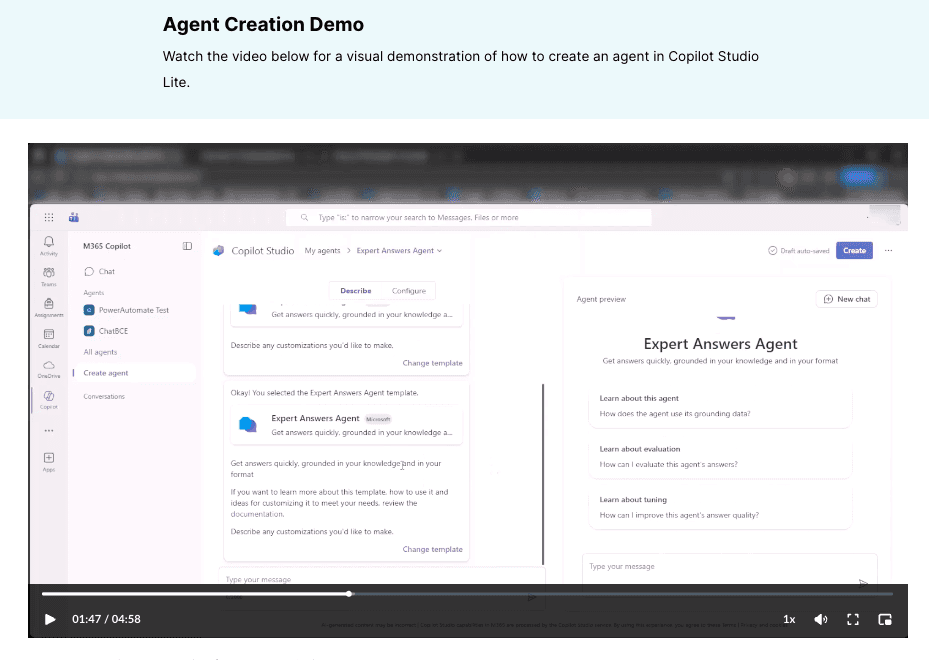
Guided demonstration of practical agent creation in Copilot Studio Lite.
Testing applied understanding
Knowledge checks were used to test whether learners could apply platform and agent-selection concepts rather than simply recall terminology.

Scenario-based assessment testing platform and agent-selection decisions.
From learning to governed practice
The training connected into a structured agent-certification pathway, reinforcing the expectation that agent creation included documentation, evaluation and responsible use.

A structured certification pathway guiding learners through evaluation of their agent design.
“Technology is the tool; your thinking is the blueprint.”