Enterprise AI Capability • Instructional Design • Responsible AI
Turning AI agent creation into a governed capability pathway
Brisbane Catholic Education
I designed the Agent Creation Training for Teachers as a controlled entry point into no- and low-code agent development. Built in Articulate Rise, the learning combined practical agent concepts, realistic school scenarios, responsible-AI requirements, governance, data safety, and applied assessment.
MY ROLE
Learning design, instructional design, content authoring, and capability pathway design
FORMAT
Articulate Rise • Synthesia • Scenario-based digital learning • Copilot Studio Agent (Kora)
TOOLS & TOPICS
M365 Copilot • Copilot Studio Lite • Responsible AI • Governance
CONTEXT
Enterprise AI capability and citizen development

An applied classification activity used to help learners distinguish between no-code, low-code, and pro-code approaches before choosing a platform or starting a build.
The challenge
As AI agents became easier to create, the challenge was not simply teaching people which buttons to press. Brisbane Catholic Education needed a way to enable teacher-led experimentation without opening the door to unmanaged agent creation.
Interest in AI agents was growing across BCE, particularly in schools where teachers could see immediate opportunities for planning, differentiation, feedback, and workflow support.
But easy access to agent-building tools created a governance problem as well as a capability opportunity.
A conventional software tutorial would have taught people how to create an agent without addressing the more important questions: Should this be an agent at all? What data is appropriate? Where does human oversight sit? Who remains accountable once an agent is being used?
The training therefore needed to do two things at the same time: build confidence to experiment and establish clear boundaries for responsible use.
“The goal was not unrestricted agent creation. It was informed, appropriate, and transparent creation within clear guardrails.”
Designing the learning pathway
The aim was to help teachers make better decisions before they built anything: whether an agent was the right solution, what information it should use, what risks needed to be considered, and what ongoing responsibilities came with creating it.
Rather than begin with the tool, I structured the learning around the decisions a responsible agent builder needs to make.

Concepts were progressively unpacked before learners were asked to classify agent types and make design decisions.
Governance was part of the design, not an add-on
The governance requirements were translated into practical learning decisions.
Teachers were asked to consider data minimisation, privacy, transparency, human oversight, testing, documentation, and lifecycle responsibilities in the context of realistic school use cases.
This was important because safe agent creation is not a one-time approval decision. Responsibility continues after an agent is created: how it is used, reviewed, maintained, shared, and eventually retired.

Governance, privacy, and data-safety requirements were embedded directly into the learning journey.
Data governance
Classify, minimise, and validate data
Privacy
Use information within clear organisational expectations
Human oversight
Keep people accountable for consequential decisions
Transparency
Make AI use visible and understandable
Testing
Check behaviour and outputs before relying on an agent
Lifecycle
Treat creation, review, maintenance, and retirement as continuing responsibilities
From concepts to practical creation
Understanding the principles was only useful if teachers could then apply them.
The learning moved into guided demonstrations of agent creation in Microsoft Copilot Studio Lite, using examples grounded in teaching and school workflows.
This allowed learners to see how decisions about purpose, instructions, knowledge sources, and outputs translated into an actual agent while keeping the governance context visible.
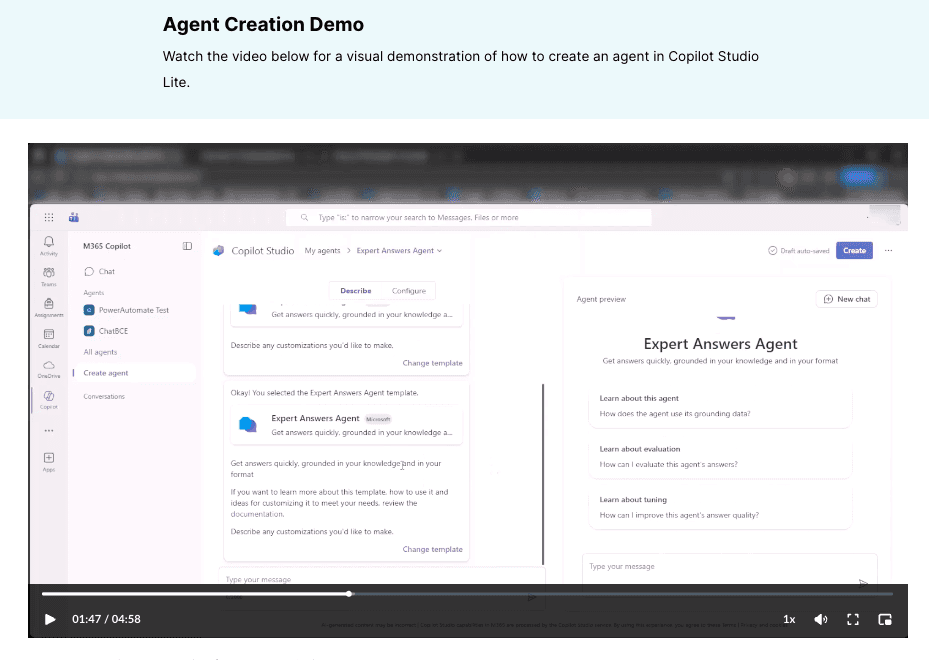
Guided demonstration of practical agent creation in Copilot Studio Lite.
Testing judgement, not just recall
The assessment approach focused on application rather than terminology.
Knowledge checks asked learners to make choices about agent type, platform, data use, and safe design. The intent was to test whether they could recognise an appropriate course of action in context, not simply remember definitions from the previous screen.

Applied questions tested whether learners could make appropriate platform and agent-design decisions.
A pathway beyond course completion
The broader design went beyond a standalone eLearning module.
The Teacher Builder pathway was conceived as the first stage of a tiered capability model: users could build awareness, trained builders could create low-risk no- and low-code agents, and more advanced makers could progress into scalable agent development.
A Graduation Agent concept — Kora — was designed as a conversational checkpoint. Learners would articulate an agent’s purpose, workflow, data sources, and intended outputs, receive feedback against criteria such as safety, explainability, and lifecycle management, and resubmit where required.

Kora was designed as a conversational graduation and licensing checkpoint, reinforcing that capability and accountability needed to progress together.
Working through governance scrutiny
The design was reviewed through BCE’s AI governance structures, including the AI Genesis Board, AI Group, and relevant working groups.
Feedback was supportive of teacher-led innovation, particularly the use of scenarios to build understanding of privacy, data, and safeguarding, but it also surfaced important questions around accountability, principal visibility, agent approval, and ongoing lifecycle management.
Those questions informed further strengthening of the pathway, including clearer accountability, leadership awareness, lifecycle expectations, and consideration of how agents could be registered and governed after creation.
“Enable innovation close to practice — but make the responsibilities visible.”
Strategic value
The training became more than an instructional-design exercise. It was a practical mechanism for translating enterprise AI strategy and governance into day-to-day behaviour.
It supported a model in which staff could experiment and build capability close to their work while maintaining organisational expectations around Responsible AI, data protection, human oversight, and governance.
For me, the important design lesson was that AI capability and AI governance should not be treated as separate programs. The strongest learning experience taught people how to use the technology and how to exercise judgement about its use at the same time.
“Technology is the tool; your thinking is the blueprint.”